Reported on:
2026-10-31
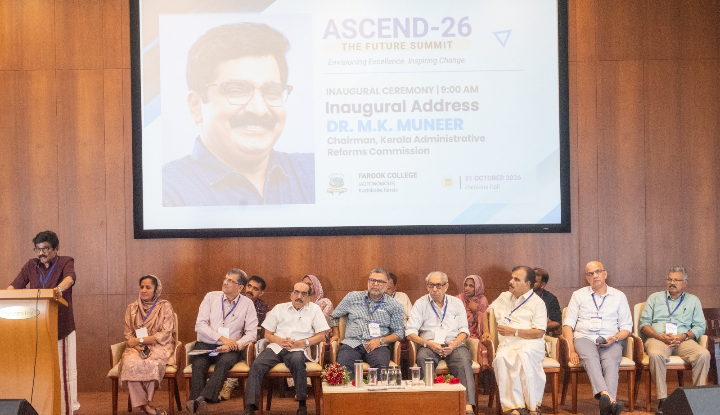
Farook College (Autonomous) organised ASCEND-26, an Edu Summit on “Envisioning Excellence. Inspiring Change,” at Parisons Hall on Saturday, bringing together the college’s management, academic leadership, faculties and experts to deliberate on the future of higher education.
Dr. M. K. Muneer, Chairman of the Kerala Administrative Reforms Commission, inaugurated the summit. Janab P. K. Ahamed, President of the Farook College Managing Committee, presided over the inaugural session. Adv. M. Mohamad, Manager of the college, delivered the keynote address, while Prof. (Dr.) K. A. Aysha Swapna, Principal, welcomed the gathering. Dr. Ali Faizal, Secretary of the Managing Committee, presented the concept note.
Felicitation addresses were delivered by Janab K. Kunhalavi, Vice-President; Janab K. V. Haseeb Ahamed, Joint Secretary; Janab N. K. Mohammed Ali, Treasurer; Prof. A. Kuttialikutty, members of the Managing Committee. Dr. Kavitha A. P., IQAC Coordinator, proposed the vote of thanks.
The summit featured expert sessions on emerging trends in higher education, institutional leadership, strategic planning, innovation and financial sustainability.
The summit featured a series of expert sessions and panel discussions led by distinguished academicians, institutional leaders, professionals and thought leaders.
Expert Sessions on the Future of Higher Education
The first session, titled “Higher Education: Global Trends,” was led by Prof. G. Simon Thattil, Academic Director, Loyola College of Social Sciences, Thiruvananthapuram. The session examined emerging global developments in higher education and their implications for academic institutions.
The second session, “Higher Education: Emerging Futures,” also led by Prof. G. Simon Thattil, focused on the evolving landscape of higher education and the need for institutions to adapt to changing academic, technological and professional environments.
The third session, “The University We Are Becoming: Five Decisions for 2041,” was led by CA V. Pattabhi Ram, Chartered Accountant, author, public speaker and educator. The session encouraged forward-looking institutional thinking and explored strategic decisions that could shape the future of higher education.
The fourth session, “Building a Future-Ready Institution: Partnerships and Sustainable Growth,” was led by CS Ashique A. M., Company Secretary and Business Consultant, and Founder of Ashique & Associates, Kozhikode. The session highlighted the importance of institutional partnerships and sustainable growth strategies in strengthening educational institutions.
Panel Discussions on Leadership, Innovation and Sustainability
The afternoon programme featured panel discussions on three major themes relevant to the future of higher education.
The panel discussion on “Governance and the Art of Leadership” was led by Dr. P. K. Babu, Chief Learning Officer, Open Circle, and Director, Academics, BenchMark International School, Tirur. The discussion focused on institutional leadership, governance and strategic decision-making for long-term academic and organisational sustainability.
The discussion on “Accelerating Start-ups and the Innovation Ecosystem” was led by Dr. Preethi M., CEO, Technology Business Incubator (TBI), National Institute of Technology Calicut. The session explored opportunities for strengthening innovation, entrepreneurship and institutional engagement with emerging professional and knowledge economies.
The panel on “Financial Sustainability and Institutional Growth” was led by N. K. Nikhil, DAAD Fellow, Rajagiri College of Social Sciences (Autonomous). The discussion addressed financial sustainability, institutional resource mobilisation and strategies for ensuring long-term institutional development.
A Strategic Roadmap for Institutional Development
ASCEND-26 was designed to examine emerging global trends in higher education and their implications for the future of Farook College. The summit also aimed to explore innovative approaches to teaching, learning, research and institutional development in a rapidly changing educational environment.
The deliberations focused on identifying opportunities to strengthen research, innovation, entrepreneurship and engagement with emerging professional and knowledge economies. Financial sustainability and the effective mobilisation of institutional resources were also central to the discussions.
A key objective of the summit was to strengthen collaboration among Heads of Departments, IQAC members, Faculties and the Managing Committee in planning and implementing future-oriented institutional initiatives.
The programme further sought to develop a shared framework for translating the deliberations into actionable institutional priorities, enabling the college to pursue sustainable academic and organisational growth.